USDT Game Balance: Why the Network Label Disappears After Crediting
When a deposit is credited, the cashier writes a number into your account. The number is the same whichever network the money came by. Nothing in the balance says Tron or Ethereum, and that is convenient until the day you need to say.
This guide is about the gap between what the chain recorded and what the account displays, and what you should keep to bridge it.
What is a USDT deposit?
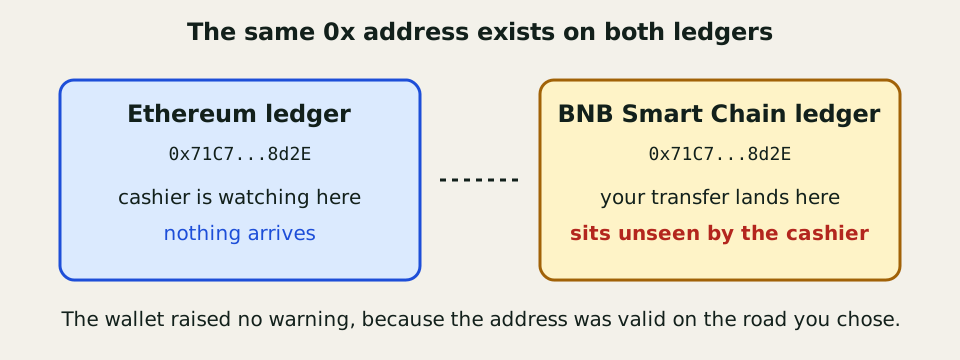
Seen from the chain, a deposit is a transfer into an address the operator controls. Seen from the account, it is a line added to a history. The first happens on a ledger anyone can read, and the second in the operator’s database, which only the operator can read. The cashier is the translator between them, and it translates only transfers on networks it watches.
Once credited, the road is gone
The balance has no route memory. Bets are entries in the operator’s own records, not transfers, so playing does not touch the network at all. This is why a deposit that took a minute or an hour looks identical afterwards, and why the account history is a weak record of how the money arrived.
Where the network matters again
At the withdrawal. You choose a network again, give an address again, and meet a minimum again. Cloudbet’s configuration shows how much the minimum can depend on the road, from 0.1 to 20 for the same coin. Duelbits labels USDT on BNB Smart Chain as BUSDT in its table, so a withdrawal screen may use a ticker you have not seen on the way in. Keep the record of how the money arrived; it tells you which road to take out.
Cashier notes to read next

Duelbits
The plainest wrong-network paragraph of the twelve, set beside a table that does not match its own example.

Cloudbet
Seven USDT networks in the operator’s own currency configuration, and a different withdrawal floor on each.

BitStarz
A visible payments table that names no network, and the page’s own data, which names two.
Quick answers
| Does the balance remember which network I used? | Nothing displayed in the account does. Keep your own record of the transaction hash and the network. |
|---|