USDT Casino Cashier Notes: What a Transfer on the Wrong Network Costs
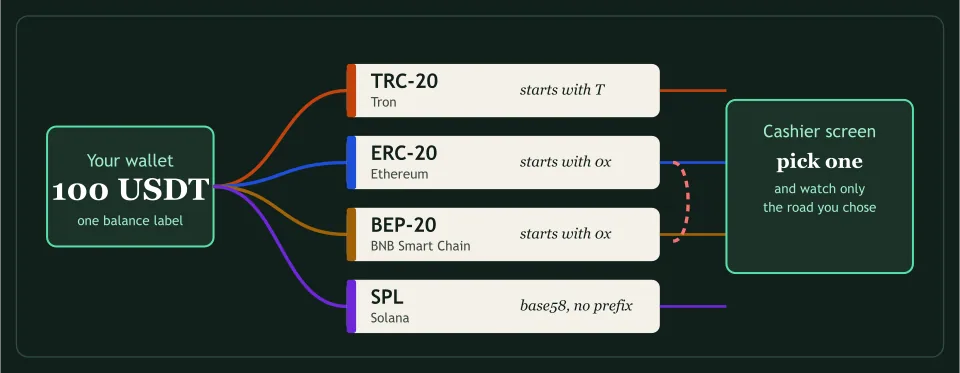
USDT is not one asset in one place. It is a family of separate tokens that share a name, one per blockchain, and a casino cashier watches only the ones it has switched on. A transfer that leaves on a road the cashier is not watching does not bounce. It arrives somewhere, on a ledger nobody at the casino is reading.
This site follows that single problem through twelve operators’ own help pages. The question on each is practical: how does this cashier take USDT in and send it out, which networks does it name, and what does it say about a transfer that went the wrong way. Choosing between the networks is a different job, and this site does not do it.
What happens if you send crypto to the wrong network?
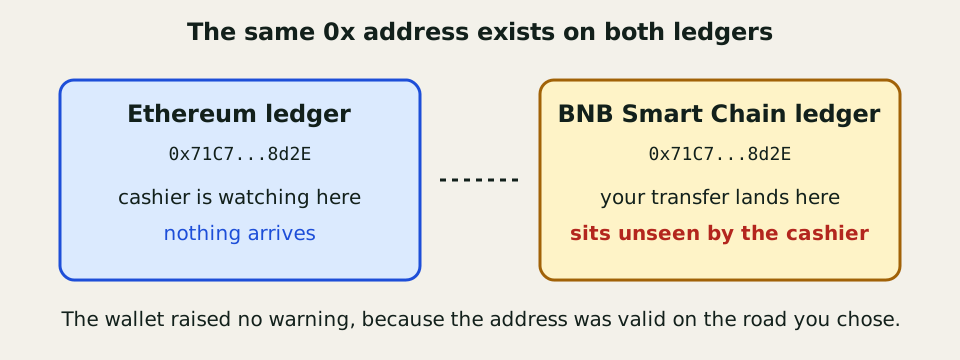
A token transfer is an entry in one blockchain’s ledger. When the entry is made on a chain other than the one the cashier monitors, three things can be true at once: the transaction succeeded, the explorer shows it, and the casino has no record of it. The sender sees “confirmed” and the account sees nothing.
How bad that is depends on who holds the key to the receiving address on the chain you used. Between networks that share an address format, the same key can control the same address on both, so the funds are reachable in principle by whoever owns the address. Reaching them is a manual job with a cost and no obligation attached. Where the formats differ, as between Tron and Ethereum, a wallet normally refuses to build the transfer at all, which is the kind failure.
The operators’ own words are blunt. Duelbits names three outcomes in order, ending with funds that cannot be retrieved. Rollbit says funds are generally unrecoverable when sent by the wrong network. Both are quoted in full on their own pages.
Can you recover crypto sent on a wrong network?
Sometimes, and never as a right. Three things decide it: whether the receiving side controls the address on the chain you used, whether it has a procedure for pulling funds off a ledger its cashier does not monitor, and whether it judges the amount worth the effort. Cloudbet’s deposit article states where it puts the burden: use the exact address on the screen, and the company is not liable for losses from incorrect information the sender provided.
Stake takes another approach in its network article. It does not describe consequences, but it publishes a list of networks it does not support, so a sender can see the wrong roads in advance. The whole worth of that list is that it is read before sending.
In the first hour after a mistake: stop sending, write down the hash, the network, the receiving address, the amount and the time, and look the transaction up on the explorer for the chain you used. The details of that sequence are in the troubleshooting guide.
“Always match the network you select with the one supported by your deposit wallet before you proceed.”
Duelbits help centre, article on supported cryptocurrencies and networks
What network should USDT be sent on?
The one the cashier’s deposit screen names for the address it shows you. Operators publish different lists: Stake names five networks for USDT, Cloudbet seven, Vave three, BitStarz two in its page data, Duelbits one plus a separate BUSDT line, Rollbit ties USDT to ERC-20. The lists differ because cashiers differ, and the screen is the only version that is current.
Labels are a hazard of their own. BSC, BNB Smart Chain, Binance Smart Chain and BEP20 are all names of one chain; TRX - Tron (TRC20), TRON and Tron are all one chain. Compare the chain and not the word. How to choose between networks is a separate subject that this site only touches.
Check the minimum deposit amount
The amount is the second way to lose a transfer that went to the right place. Cloudbet says any amount below the minimum will not be credited. Rollbit says in capitals that deposits below its minimums will not credit and cannot be recovered by support. So a test transfer has to clear the minimum for the network you chose, or the test is itself the loss.
Minimums are the operator’s and sometimes differ by network: Vave’s table gives three different figures for USDT on three networks. They are quoted on the page of each operator that publishes them and nowhere else.
Check the explorer
Every chain has a public explorer, and a transaction hash is known only on its own chain. Duelbits’s table names etherscan.io for Ethereum, bscscan.com for Binance Smart Chain, tronscan.org for Tron and solscan.io for Solana. If the explorer for the chain you used shows the transfer, note the receiving address and the token it names. If it has never heard of the hash, you are on the wrong explorer or the transfer did not leave.
What these pages do not say
There is no welcome offer here, no rollover figure, no licence number and no star rating for any operator. The pages this site replaces stated none, and a figure copied from somewhere else would only be a guess with a logo on it. Where an operator’s own page gives a number, the sentence says whose page and which article. Where the page could not be read, the note says so.
Twelve cashiers, and what each says about USDT

Stake
Five USDT networks on its list, and the rarer thing: a published list of networks it does not support.

Cloudbet
Seven USDT networks in the operator’s own currency configuration, and a different withdrawal floor on each.

Duelbits
The plainest wrong-network paragraph of the twelve, set beside a table that does not match its own example.

Rollbit
A one-sentence warning about the network, and a five-dollar floor below which support cannot recover a deposit.

Vave
Three USDT networks and three different minimums, from help articles last updated in 2023.

BitStarz
A visible payments table that names no network, and the page’s own data, which names two.

Roobet
Names USDT inside a closed coin list and says lost funds follow anything outside it; says nothing about networks.

Sportsbet.io
Names USDT and quotes a very low floor, and names no network anywhere in its page text.

BetFury
Lists USDT among its coins, talks about “a convenient network”, and asks you to check all the data.

BC.GAME
Its front page names six coins and tokens in general terms; USDT is not among them, which proves nothing either way.

FortuneJack
Its pages could not be read at all, so this note claims nothing and says how to ask before sending.

CoinCasino
A cashier text could be read but could not be tied to this brand, so nothing from it is attributed here.
Short answers
| Is a wrong-network USDT deposit always lost? | No, but nothing obliges anyone to return it. Operators’ pages range from “generally unrecoverable” to silence. |
|---|---|
| Does a confirmed transaction mean the casino received it? | Confirmed means the chain recorded it. Credited means the cashier saw it on a chain it watches. |
| Is there any USDT address on this site to send to? | No. It holds no balance and has no login. Links to operators are affiliate links and are marked as such. |