USDT Deposits and Withdrawals: What Twelve Cashiers Say About Networks
Twelve operators, twelve ways of saying very little or a great deal about the road a USDT transfer should take. This page sorts them by what they actually state: a list of networks, a warning about the wrong one, only the coin’s name, or nothing readable.
Everything below was read from the raw source of a page the operator publishes. Each operator has its own page with the quotations in full.
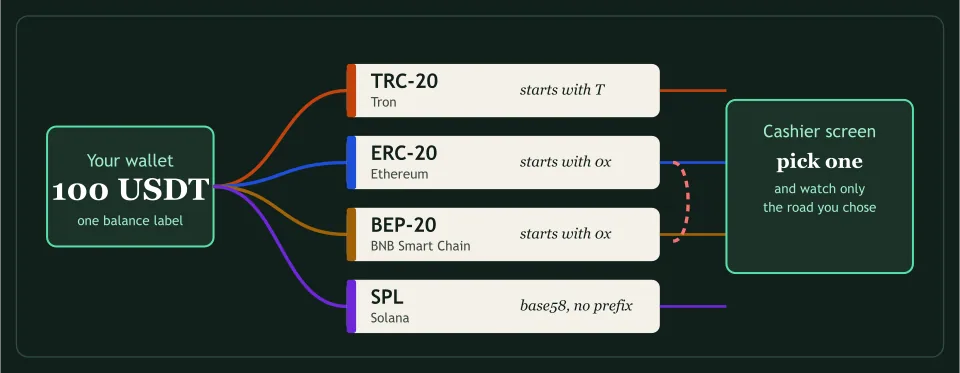
Which networks can USDT be sent on?
Six operators give a list or a partial one. Stake names five in one table cell: ERC20, BSC (BEP20), Polygon, TRX - Tron (TRC20) and SOL - Solana. Cloudbet’s own configuration lists seven, adding Avalanche C-Chain and The Open Network. Vave’s one-line article names ERC20, TRC20 and Solana. BitStarz’s visible table names none, but its page data carries Tron TRC20 and Ethereum Mainnet ERC20. Rollbit’s article ties USDT to an array of ERC-20 tokens. Duelbits’s table lists USDT on Ethereum [ERC-20] and BUSDT on Binance Smart Chain.
The lists are not interchangeable and the page text for no two of them is built the same way, so a sender who has used one cashier cannot assume a second one offers the same roads.
Who warns about the wrong network in so many words
Duelbits is the plainest, with a three-step ladder of outcomes that ends with unrecoverable funds. Rollbit says funds are generally unrecoverable if sent via the wrong network. Cloudbet says it is not liable for losses resulting from incorrect information provided. Stake prints a list of unsupported networks and an instruction to send coins through their corresponding networks. BetFury asks the sender to check all the data to avoid loss of funds. Roobet warns that any coin outside its closed list will be lost, which is a warning about the coin and not the road.
The word choice is informative. “Generally”, “can lead to” and “not liable” are all different positions about a loss, and none of them is a promise.
Who names the coin and nothing more
Sportsbet.io names USDT and a minimum deposit from 0.25 USDT or USDC, and no network. Roobet names USDT inside a closed coin list and points to an Ethereum explorer for USDT transactions without saying which networks the cashier accepts. BetFury lists USDT among its accepted currencies and writes about network choice using ETH as the example.
Who could not be read
BC.GAME’s front page describes support for BTC, ETH, DOGE, TRX, XRP, UNI and DeFi tokens, and its cashier text is drawn in the browser. USDT is not named there, which is not the same as refused. FortuneJack’s pages refused every request, so nothing is said. A cashier at a site named CoinCasino could be read, but nothing ties it to the brand this site covers, so none of it is used.
How long before a USDT deposit shows up?
Roobet says three confirmations for USDT and gives no estimate of their duration. BitStarz’s page data fixes 19 confirmations on the Tron route and 10 on Ethereum Mainnet. Duelbits says deposits usually arrive within five minutes and may take longer in congestion. BetFury says in rare cases a deposit may take 24 to 72 hours. None of the four is a promise about your transfer.
Four cashiers that publish a network list

Stake
Five USDT networks on its list, and the rarer thing: a published list of networks it does not support.

Cloudbet
Seven USDT networks in the operator’s own currency configuration, and a different withdrawal floor on each.

Duelbits
The plainest wrong-network paragraph of the twelve, set beside a table that does not match its own example.

Vave
Three USDT networks and three different minimums, from help articles last updated in 2023.
Short answers
| Which operators name USDT networks? | Stake, Cloudbet, Vave, Duelbits and Rollbit in their pages, and BitStarz in its page data. Roobet, Sportsbet.io and BetFury name the coin only. |
|---|---|
| Does a missing network mean it is not accepted? | No. A list without a statement that nothing else is taken says what is included, not what is excluded. |